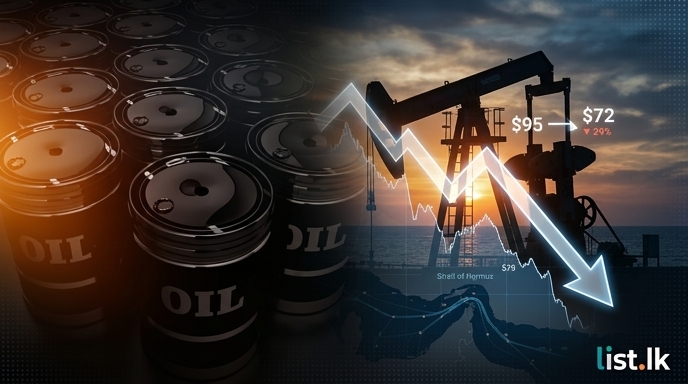
Global oil prices have surged, with Brent crude climbing above $110 a barrel for the first time in three weeks, as the Strait of Hormuz remains closed and a fragile ceasefire between the United States and Iran faces significant challenges. The critical shipping lane's status has become a central point of contention in the ongoing conflict, leading to dramatic fluctuations in global energy markets.
The volatility began on April 8, 2026, when a conditional two-week ceasefire was brokered between the U.S. and Iran, mediated by Pakistan. The agreement stipulated Iran would ensure the complete and safe opening of the Strait of Hormuz if attacks against it ceased. This initial breakthrough caused crude oil prices to plunge, with Brent crude falling approximately 15.9% to $92.30 per barrel and US-traded oil declining about 16.5% to $93.80 per barrel. Global stock markets rallied on eased supply disruption fears.
However, optimism was short-lived. By April 10, prices began to rise again, with Brent crude reaching $96.75 a barrel, amidst concerns over the ceasefire's stability and the Strait's continued closure. Reports of attacks on Saudi Arabia’s oil and natural gas facilities, including the East-West Pipeline, further fueled the increase. Days later, on April 15, prices saw a two-day decline, driven by renewed hopes for dialogue and easing concerns over supply risks from a U.S. blockade of the Strait of Hormuz, which the U.S. military announced would extend eastward. During this period, Brent crude fell to $94.27 a barrel and U.S. West Texas Intermediate (WTI) crude to $90.24.
Oil prices showed mixed movements later on April 15, with Brent crude futures rising to $95.22 a barrel while WTI crude fell to $91.11. The Strait of Hormuz remained closed, continuing to constrain oil exports, even as the U.S. President spoke of a calming war situation in the Middle East.
A significant shift occurred on April 17, when global oil prices experienced a substantial decline of over 10%, with Brent crude falling to $88 a barrel and WTI crude dropping to $84 a barrel. This decrease was primarily attributed to Iran's decision to open the Strait of Hormuz, reversing its previous blockade. U.S. President Donald Trump subsequently announced that Iran had agreed never to close the Strait of Hormuz again, stating it would not be used as a weapon. Iran's Foreign Minister confirmed the Strait would be "completely open" for all commercial vessels during the ceasefire, though maritime groups were still verifying full implementation.
This period of openness proved brief. By April 20, global crude oil prices rose significantly, reversing previous declines, as the Strait of Hormuz reportedly re-closed. This re-closure followed accusations from both the U.S. and Iran of ceasefire violations, including attacks on ships over the weekend. Iran announced on Saturday that it was closing the Strait again and would target any approaching ship. U.S. President Donald Trump confirmed that U.S. forces had intercepted and seized an Iranian-flagged cargo ship. On Monday, Brent crude prices jumped by over 6% to $96.49 a barrel, while WTI crude climbed to $90.38 a barrel.
Amidst these escalating tensions, U.S. President Donald Trump announced on April 22 an extension of the ceasefire with Iran until peace talks progressed. However, he stated the U.S. would maintain its blockade of Iranian ports until Tehran presented a "unified proposal." Despite the extended ceasefire, global oil prices experienced a significant jump on April 23 after Iran vowed not to reopen the Strait of Hormuz as long as the U.S. naval blockade persisted. Brent crude rose 3.62% to $105.63 a barrel, and WTI crude climbed 4.06% to $96.73 a barrel.
As of April 27, the global oil price has climbed above $110 a barrel, with Brent crude up 2.7% to $111.2 a barrel and WTI up 2.3% to $98.5 a barrel. This surge reflects traders' concerns that the U.S. and Iran are no closer to a deal to end the war and fully reopen the vital Strait of Hormuz. Iran has offered to end its chokehold on the Strait in exchange for the United States lifting its blockade and an end to the war, proposing that discussions on its nuclear program would come in a later phase. However, President Trump has signaled he is unlikely to accept this offer, which was passed to the Americans by Pakistan, leaving unresolved the disagreements that led the U.S. and Israel to go to war on February 28.