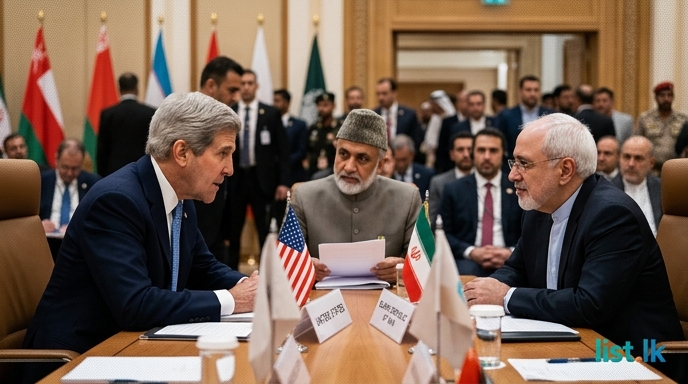
A two-week conditional ceasefire between the United States and Iran, brokered by Pakistan, was announced by US President Donald J. Trump on April 7, aiming to de-escalate a six-week-old conflict that had claimed thousands of lives and disrupted global energy supplies. The agreement came less than two hours before a deadline Trump had set for Iran to reopen the Strait of Hormuz, a critical shipping lane.
Intensified diplomatic efforts, led by Pakistan's mediation, resulted in the proposed 'Islamabad Accord', which envisioned an immediate cessation of hostilities to facilitate the opening of the Strait of Hormuz, followed by a broader peace agreement within 15 to 20 days. Initially, Iran had not formally committed to any agreement, with its foreign ministry spokesperson Esmaeil Baghaei stating that earlier U.S. demands, including a "15-point plan," were rejected as "excessive" and that negotiations were "incompatible with ultimatums and threats to commit war crimes."
President Trump announced a "double sided CEASEFIRE" – a two-week suspension of US bombing and attack operations against Iran – following discussions with Pakistan's Prime Minister Shehbaz Sharif and Chief of Army Staff, Field Marshal Asim Munir. Trump stated the ceasefire was conditional on Iran agreeing to the "COMPLETE, IMMEDIATE, and SAFE OPENING of the Strait of Hormuz." This announcement came after a stark warning from Trump that "a whole civilisation will die tonight" if his demands were not met.
In response, Iranian state media, citing the Supreme National Security Council, reported a "historic victory" and a confirmed two-week ceasefire, claiming the US accepted Iran's "10-point plan" and its control over the Strait of Hormuz. Iran's Foreign Minister Seyed Abbas Araghchi formally declared the conditions for halting military operations and allowing safe passage through the Strait of Hormuz, acknowledging Pakistan's diplomatic efforts. Iran's Supreme Leader, Mojtaba Khamenei, directly instructed all military units to cease fire, though he clarified that this agreement was "not the end of the war" and Iran's forces remained prepared.
Iran's 10 conditions for a conditional ceasefire included: stopping wars against Iraq, Lebanon, and Yemen; permanently ending war against Iran; ending all regional conflicts; reopening the Strait of Hormuz and ensuring its navigation security; full compensation for Iran's reconstruction costs; US commitment to lift sanctions; and release of Iranian funds and frozen assets. Foreign Minister Araghchi warned the US that it must choose between a ceasefire and "continued war via Israel," highlighting "massacres in Lebanon."
Israel initially agreed to suspend its bombing of Iran for the two-week ceasefire period. However, Israel's Prime Minister Benjamin Netanyahu's office later clarified that the ceasefire "doesn't include the war with Hezbollah in Lebanon," directly contradicting Pakistan's Prime Minister Shehbaz Sharif, who had stated the ceasefire covered "everywhere," including Lebanon. The US reportedly assured Israel of its commitment to addressing Iran's threats in upcoming negotiations. Despite Israel's assertion, Hezbollah halted its attacks on Israeli troops and territory since the ceasefire announcement, though the Israeli military issued new evacuation orders for civilians in southern Lebanon.
Hours after the initial ceasefire announcement, missile attacks were reported across the Gulf and in Israel, with Kuwait, the UAE, and Bahrain reporting incoming drone and missile threats. Reports also indicated that Iran and Israel violated the ceasefire by launching attacks against each other. Furthermore, Iran's Lavan Island oil refinery, a key crude oil export terminal, was reportedly hit by an "enemy attack." President Trump later accused Iran of violating the ceasefire agreement by firing bullets in the Strait of Hormuz on Saturday, reportedly targeting a French ship and a UK freighter.
The White House, through press secretary Karoline Leavitt, declared the two-week ceasefire a "victory for the United States," asserting that the US military achieved its core objectives in 38 days, creating leverage for diplomatic solutions. Pakistan's Prime Minister Shehbaz Sharif formally invited leaders from the US and Iran to Islamabad for further negotiations, with initial talks scheduled for April 10.
International reactions were cautious but hopeful. UN Secretary-General Antonio Guterres welcomed the agreement, while leaders from Malaysia, Japan, and Australia expressed cautious optimism. However, Iran's ambassador to the U.N. in Geneva stated that Iran would approach peace talks with the U.S. with greater caution due to a deep lack of trust, adding that the war would affect the future legal regime of the Strait of Hormuz.
Talks between Iran and the United States commenced in Islamabad, with Iranian state broadcaster IRIB reporting their start. These negotiations, later confirmed as direct, represented the highest-level face-to-face discussions between the two nations since 1979. Amid these developments, Iran’s supreme leader, Mojtaba Khamenei, declared a "final victory" against the US and Israel, stating Iran had "astonished the world" and was not seeking war. Conversely, US President Donald Trump asserted that Iran was "LOSING BIG" in the conflict.
Direct talks in Islamabad, which lasted 21 hours, concluded without a deal to end the war, casting uncertainty over the fragile ceasefire. Both sides blamed each other for the breakdown; US officials stated Iran would not commit to abandoning its nuclear program, while Iranian leaders blamed Washington. Despite the lack of agreement, Pakistani Prime Minister Shehbaz Sharif confirmed that efforts to resolve the conflict were still under way and that the ceasefire remained in effect.
Amid escalating tensions, the US declared a blockade of Iran’s ports, prompting Tehran to threaten to strike targets across the region. Despite this, US officials and President Trump indicated that a second round of peace talks could resume in Islamabad as early as Thursday or within the next two days. Trump stated the war with Iran was "nearing its end" and expressed his belief that Iran was "very eager to reach an agreement." The White House clarified that the United States had not formally requested an extension of the current ceasefire, pushing back against media reports, though negotiations continued behind the scenes.
President Trump later stated he might visit Islamabad if a peace deal with Iran was reached and signed, adding that Iran had agreed to "almost everything" and to hand over its enriched uranium supply. Trump indicated the two sides were "close" to a peace deal and that he could extend the current ceasefire, which was set to expire next week, but might not need to. Separately, Trump announced that Israel and Lebanon had agreed to a 10-day truce commencing on Thursday, with Iran-backed Hezbollah stating it would respect the ceasefire if Israeli attacks ceased. Trump urged Hezbollah to hold its fire and indicated that the next meeting between the United States and Iran could take place at the weekend.
However, Trump later stated that the current ceasefire with Iran might not be extended if an agreement was not reached by next Wednesday. While Trump reiterated that Iran had agreed to hand over its enriched uranium, Iranian authorities rejected this claim as false, stating they were not ready to export their enriched uranium. Separately, Iran's Parliament Speaker warned that the Strait of Hormuz could not be kept open indefinitely if US naval blockades on Iranian ports were not immediately lifted. Trump explicitly warned that attacks would resume and the US would "start dropping bombs again" if a peace deal was not reached before the ceasefire expired next week. Trump also confirmed that the blockade of the Strait of Hormuz would remain if no agreement was reached. Iranian sources indicated that a second round of peace negotiations was expected to be held on Monday, with US representatives traveling to Islamabad for negotiations.
Iran's top negotiator stated that recent talks with the US made progress but still had gaps concerning nuclear issues and the Strait of Hormuz. President Trump described these conversations as "very good" but warned against "blackmail" regarding the key shipping channel. As the ceasefire's original two-week period, which began on April 7, drew to a close, President Trump stated he now considers the ceasefire with Iran over "Wednesday evening Washington time" and that it is "highly unlikely" he would extend it further if a deal is not reached. "I’m not going to be rushed into making a bad deal. We’ve got all the time in the world," Trump said.