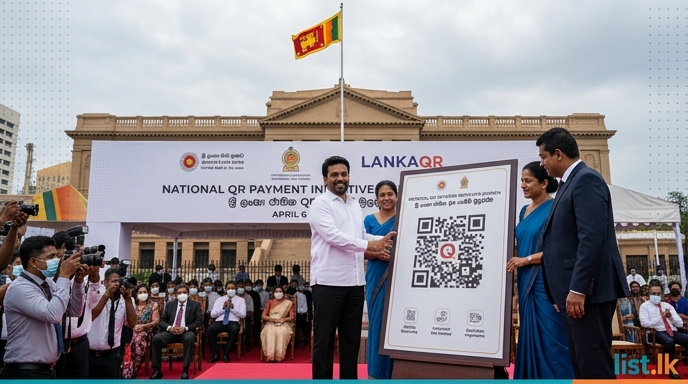
Sri Lanka officially launched its National QR Payment Promotion Project on April 6th, marking a significant stride towards a digital economy. The initiative, presided over by President Anura Kumara Dissanayake at the Presidential Secretariat, is a collaborative effort between the Ministry of Digital Economy and the Central Bank of Sri Lanka. The launch event, which commenced at 9:30 AM, was hailed as a new milestone in the nation's digital transformation.
A cornerstone of the program is the complete removal of the Merchant Discount Rate (MDR) for all LankaQR transactions up to Rs. 5,000, effective from the launch date. This crucial measure aims to empower small-scale businesses to embrace digital payment methods without incurring additional costs, thereby fostering greater financial inclusion and economic efficiency. The President's Media Division (PMD) confirmed the immediate effect of this fee waiver, which is being implemented by financial institutions.
The overarching goal of the initiative is to steer Sri Lanka towards a cash-lite economy, reducing reliance on physical coins and banknotes. Beyond this, the project seeks to enhance economic efficiency, financial inclusion, and financial transparency. President Dissanayake highlighted the ambition to transform the informal economy into a formal economy and set a target to build a $15 billion digital economy by digitizing various sectors.
Dr. Hans Wijesuriya, Chief Advisor to the President on the Digital Economy, emphasized the need for collective responsibility from service providers, financial institutions, and consumers to accelerate digital payment adoption. He revealed a national target of one million QR transactions per month.
President Dissanayake expressed confidence that the initiative would rapidly popularize QR payments, citing past successes like fuel QR codes as evidence of Sri Lankan society's readiness to embrace efficient and practical new systems. He stressed the importance of popularizing the QR transaction method as a "cultural transaction" within society, highlighting that digitalizing transactions would make them reliable and secure. The President also identified the upcoming New Year period as a critical juncture for the initiative, stating that "turning New Year transactions into QR payments will be a turning point" for the country's digital economy.
Following the launch, President Dissanayake met with heads of banks and financial institutions at the Presidential Secretariat. During this meeting, Central Bank Governor Dr. Nandalal Weerasinghe noted the significant costs incurred by the banking system for providing ATM services. Discussions focused on how the banking system could further support making the QR payment method more convenient and attractive to the public.
Separately, while addressing the launch event, President Dissanayake also announced a decision to provide a subsidy of up to Rs. 100 for diesel, considering fluctuations in global fuel prices.