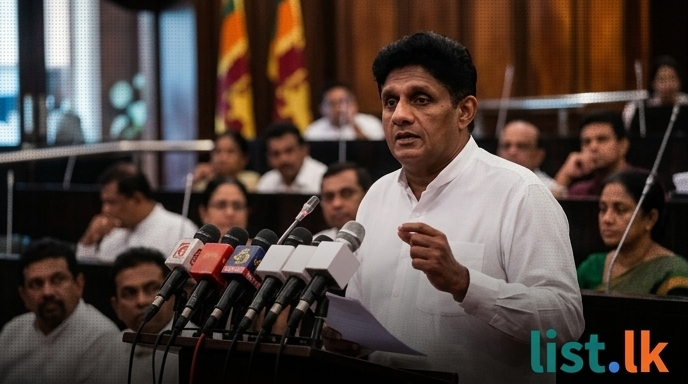
Opposition Leader Sajith Premadasa has launched extensive and ongoing criticism against the government, asserting that Sri Lanka faces significant national dangers impacting food security, economic, social, and political sovereignty. He contends that the country is experiencing its "sixth tragedy" and that the government is engaged in daily deception, misleading the public with inaccurate figures and projecting a false sense of stability.
Speaking on June 1, 2026, Premadasa criticized politicians, stating that lying politicians are more prominent than working ones. He further elaborated on the nation's economic woes, describing Sri Lanka as facing a severe economic crisis where household economies have collapsed, impacting millions of lives. He pointed to dwindling foreign reserves and a slowdown in the development pace of the export sector. On June 2, he highlighted that millions are unable to afford daily meals, leading to increased poverty, and pointed to the collapse of industries and soaring fuel and electricity prices as key issues. He stressed that collective responsibility is crucial to care for the suffering populace and urged unity in overcoming economic hardships.
Premadasa highlighted the severe economic challenges, including the rising cost of living, income inequalities, and increasing financial hardship faced by the public. He questioned the government's strategic approach to macroeconomic and microeconomic management and sought clarity on the reasons behind the Sri Lankan Rupee's continued depreciation, which he warned is detrimental to the country. He directly linked the rising prices of essential goods such as fuel and milk powder to the nation's economic risks, accusing the government of increasing these prices while simultaneously claiming there are no economic problems.
Regarding the country's financial stability, Premadasa urged the government to immediately pursue a successor IMF program, warning that current extended loan facilities will cease after March 2027. He noted that Sri Lanka's IMF reserves have fallen to 50% of the required USD 14.2 billion, with diminishing opportunities to secure the remaining funds, and that debt repayment obligations will increase from 2027. He emphasized that Sri Lanka is not on track to meet reserve targets under the current arrangement and that global aid is necessary for recovery. Premadasa also challenged the President's claims of USD 7 billion in reserves, explaining that a significant portion is held in unusable Chinese Yuan, meaning actual usable reserves are less than USD 7 billion and fall short of the international standard requiring reserves to cover three months of imports. He pointed to Bangladesh also seeking a more realistic IMF arrangement as an example Sri Lanka should follow to ease the burden on its citizens.
Premadasa condemned the government's taxation policies, describing the new approach as a "deadly blow to democracy". He criticized the additional 50% tax on vehicles, arguing it breaks election promises and contradicts claims that car prices would not rise, recalling the government's election promise to make a Vitz car available for Rs. 1.2 million. He held the President and 159 government MPs responsible for this tax. Speaking with tax administration experts and businessmen, Premadasa warned that the government's eagerness to surpass IMF targets has created a dangerous connection between tax administration and criminal activity, where negligence in fulfilling tax administration conditions could be considered a criminal act. He also questioned the government's plan for tax collection following its decision to completely remove the CESS tax by 2029 (or 2028), warning that this move poses significant risks to domestic industries, employment, and tax revenue, potentially pushing Sri Lanka from a production-based economy towards an import-driven one. During a parliamentary debate, he accused the government of imposing higher taxes on the public (including VAT increases) while offering tax concessions to cigarette companies, claiming this policy, which allegedly reduced tobacco taxes contrary to WHO guidelines, has resulted in a loss of Rs. 17.3 billion for Sri Lanka.
Sector-specific criticisms included:
* Fuel and Gas: Despite the country possessing resources, access is hindered by various pressures. Premadasa repeatedly questioned the transparency and efficiency of the fuel procurement process in Parliament, demanding information on new suppliers, exclusions, and actions against defaulting suppliers. He called on the government to reduce fuel prices, citing the recent decline in global crude oil prices. He argued that while global prices were previously used to justify domestic price hikes, consumers are not benefiting from the current lower global rates, noting that crude oil prices have fallen to pre-Middle East conflict levels.
* Electricity: He condemned the 18% increase in electricity tariffs, labeling it a burden on consumers resulting from a 'bad coal scam'. He accused the government and the Public Utilities Commission of Sri Lanka (PUCSL) of imposing the cost of substandard coal onto the public. Furthermore, he alleged that the government is deliberately working to destroy the renewable energy sector, having failed to pay Rs. 10 billion owed to renewable energy owners since December, with an additional Rs. 2.5 billion accumulating monthly. He stated the government promised to reduce electricity bills but instead acted to abandon 750,000 electricity consumers.
* Agriculture: Premadasa stated that the government has destroyed the livelihoods of farmers despite promises of empowerment. He highlighted nationwide shortages of eggs and fertilizer, including a shortage of egg seeds, and accused the relevant minister of misleading Parliament. He noted that farmers currently have no fertilizer and are struggling to sell their harvests at stable high prices. Paddy, which previously sold for Rs. 90 per kilo, now sells for Rs. 114 per kilo (after 14% moisture reduction), resulting in no profit for farmers despite incurring high costs. He also questioned the government's formula for determining the guaranteed price of paddy, emphasizing the need for transparency in calculating production costs, including seed paddy, fertilizer, agrochemicals, and machinery. He sought details on how Sri Lanka's annual fertilizer demand is being met through government and private-sector procurement.
* Fisheries: He highlighted the plight of traditional Madel fishermen in Hambantota, stating they are losing their licenses and facing issues with landing sites and boat allocations despite being in the profession for 22 years. He noted that despite promises of multi-day boats, they are receiving single-day vessels, and their legal licenses have been revoked.
Premadasa also expressed concern that Sri Lanka is becoming a "playground for geopolitics" due to its current situation, warning against allowing external forces to dictate internal affairs and stressing the need to build indigenous economic and political stability and prevent external interventions. He stated that various parties are taking advantage of the country's dangerous situation to directly and indirectly contribute to eroding Sri Lanka's sovereignty through different tactics. He drew a parallel between current rulers and ancient kings, emphasizing that leaders should not abandon people during difficult times. On June 4, he called for national unity and urged citizens to face the nation's challenges together without division, stressing the importance of acting collectively to protect the country's sovereignty, territorial integrity, and political freedom. He described the current situation as one where the populace is confronting extremely dangerous challenges, leading to immense pressure and distress in their lives.
Further concerns raised by Premadasa include:
* Misuse of PTA: On June 10, he alleged that democracy has been undermined by the misuse of the Prevention of Terrorism Act (PTA) and stressed the urgent need for a robust, long-term civil society movement to serve as a check and balance.
* Judicial Independence: On June 12, Premadasa, along with 12 opposition MPs, submitted a letter to Speaker Dr. Jagath Vikramanayake, urging him to request the President to immediately fill vacancies in the Supreme Court and Court of Appeal and calling for the protection of judicial independence.
* Environmental Policy: He emphasized the need for a national forest conservation and wildlife policy, criticizing the current environmental approach as merely temporary measures to address immediate crises rather than a comprehensive national strategy.
* El Niño Threat: On June 14, Premadasa issued a warning regarding the potential impact of a severe El Niño event on Sri Lanka. Citing international data, he stated there is a 63% probability of a 'super El Niño', comparable to the destructive events of 1997-1998, 2015, and 2016, with Pacific Ocean temperatures rising by 2.3°C. He outlined potential consequences including reduced monsoon rains, damage to agriculture, heat stress, torrential rains, severe drought, and untimely floods and landslides. He stressed the need for the country to face this threat carefully and called for the urgent establishment of a task force to prepare for the situation. He noted that he had previously raised these concerns on April 7th at the Parliamentary Forum on Climate Change, where discussions with experts indicated that both El Niño and subsequent La Niña conditions could be severe.
Premadasa announced that the Samagi Jana Balawegaya (SJB) would hold a special discussion with all opposition parties on these issues, calling for the government to engage in proper parliamentary discussion to prevent a major tragedy and for all to unite for the 22 million people.