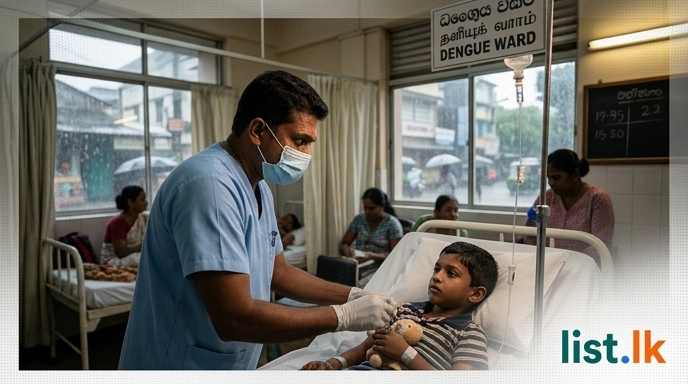
Sri Lanka is grappling with a severe and rapidly escalating dengue crisis, with health authorities declaring a "dengue hyper-epidemic". As of July 19th, the cumulative number of cases for the year has surged to 76,044, accompanied by 53 deaths. The current situation is predicted to be even more severe than the benchmark epidemic of 2017, with daily new cases frequently exceeding 1,000 and reaching a peak of 2,652 on July 19th alone.
The surge is largely attributed to the widespread circulation of a new virus strain, Dengue Virus Serotype 2 (DENV-2), which accounts for 88% of reported cases and has rendered a larger portion of the population susceptible due to low human immunity. This, combined with unfavorable weather conditions, has led to a significant increase in mosquito breeding grounds. The Aedes aegypti mosquito is the principal vector, and its population increases consistently precede major outbreaks. Mosquito larvae density, measured by the Breteau Index, has seen an alarming fivefold increase in some areas, reaching 25 compared to a normal level of around 5. Poor waste management by local government bodies is also a significant contributing factor, creating ideal breeding sites.
The epidemic's impact is widespread across the island. The Western Province accounts for the highest number of cases with 39,667, followed by the Southern Province with 11,610 cases, the Central Province with 6,325 cases, and the Sabaragamuwa Province with 6,305 cases. Within the Western Province, Gampaha district has reported 15,762 cases, closely followed by Colombo with 15,000 cases. Matara District in the Southern Province has recorded 5,280 cases. Health authorities have identified 162 high-risk Medical Officer of Health (MOH) divisions across 14 districts, with specific areas like Maharagama, Panadura, Biyagama, Ratnapura Municipal Council areas, Kadawatha, Piliyandala, and Moratuwa noted for rapid spread.
The progression of the epidemic has been alarming:
* January: 7,866 cases
* February: 5,721 cases
* March: 6,013 cases
* April: 5,651 cases
* May: 8,590 cases
* June: A staggering 21,537 cases were reported.
* July: The first 19 days of July alone saw 20,666 cases, indicating a continued rapid increase.
School children are particularly vulnerable, with pediatricians advising parents to seek dengue testing for children within 48 hours of fever onset. The escalating number of patients has led to hospitals reaching maximum capacity, with reports indicating two to three dengue patients sharing a single bed in some facilities. The Government Medical Officers' Association (GMOA) and the National Dengue Control Unit (NDCU) have warned that the entire hospital system faces a severe risk of collapse if the situation is not controlled. The academic community has also been affected, with 71 students at Colombo University contracting dengue (5 requiring hospitalization), leading to some faculties adopting online or hybrid lecture formats. The University of Moratuwa has been temporarily closed due to the escalating dengue risk.
Notably, 37 of the 53 deaths have been among women. Health officials are urging women to seek immediate medical attention due to a higher fatality rate among them, attributed partly to continuing household duties without adequate rest.
In response to the crisis, a large-scale three-day special mosquito control program commenced on June 24th, focusing on approximately 600 Grama Niladhari divisions and 112 MOH divisions. This operation, which concluded on June 26th, saw Public Health Inspectors (PHIs) granted nationwide authority to conduct inspections and eliminate breeding sites. The program specifically targeted all schools, preschools, and educational institutions, as well as government institutions and religious places, which have been identified as high-risk categories. Inspections are also underway in government and private offices. A new special mosquito control program, coordinated by the Clean Sri Lanka program under the Presidential Secretariat, commenced on July 13th and is currently active in 63 Medical Officer of Health (MOH) divisions across 11 high-risk districts, with 23 of these located in the Western Province.
Dr. Kapila Kannangara, Acting Director of the NDCU, emphasized that the public does not fully grasp the severity of the risk. To aid in reporting breeding sites, a new hotline, 0117 966 366, has been introduced. Health authorities are also urging the public not to hide dengue diagnoses and to promptly inform Public Health Inspectors, as some individuals are reportedly concealing results from private laboratory tests. The Police have also warned of strict legal action against individuals maintaining dengue breeding sites, initiating 4,672 legal cases between January and June for such offenses. Joint dengue control programs involving the Ministry of Health, Public Health Inspectors, and the Police are ongoing. Experts continue to stress the urgent need to strengthen preventive measures to curb the escalating spread and prevent the situation from worsening further, particularly warning that the next two weeks are extremely dangerous for dengue spread due to increased mosquito larvae density. In a measure to protect students, schoolchildren are now permitted to wear suitable clothing covering arms and legs along with their uniforms.