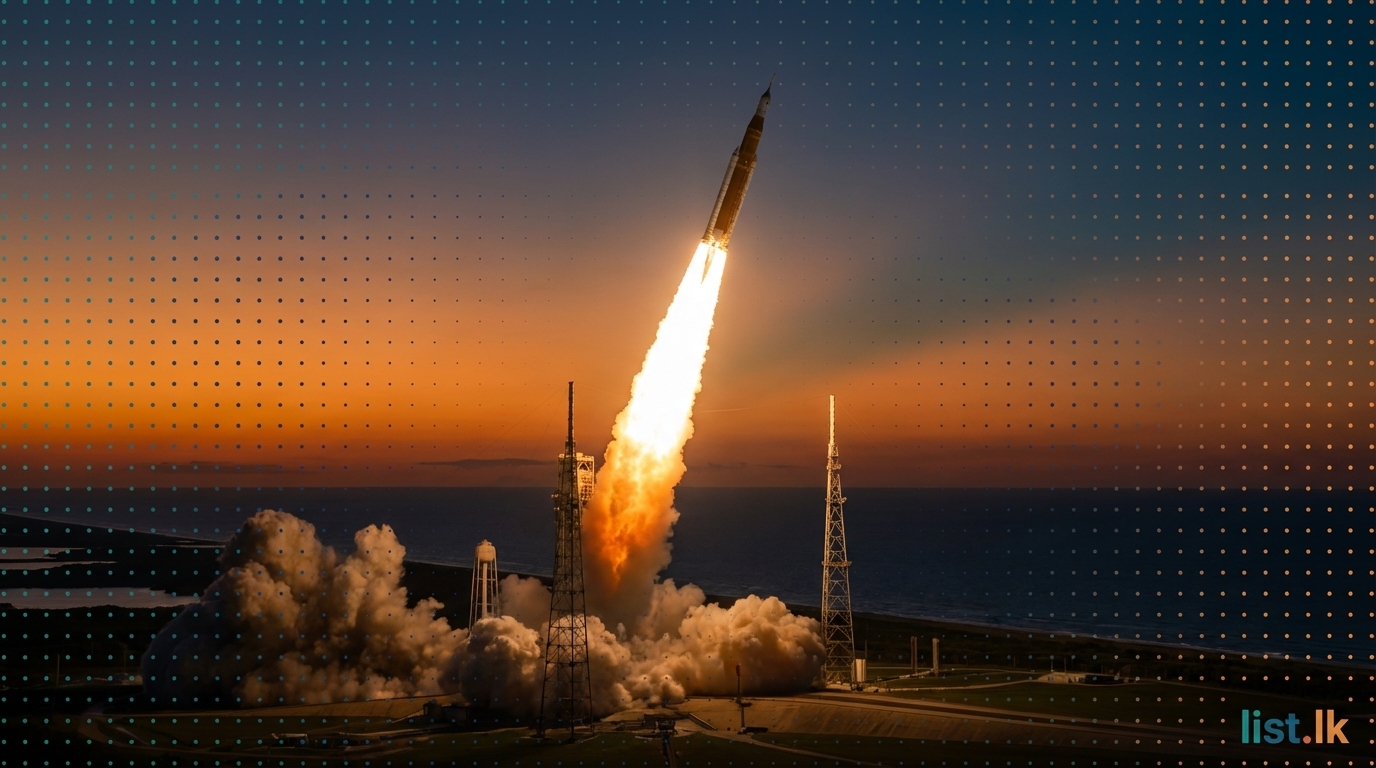
NASA's Artemis II mission has successfully completed a historic journey around the Moon, marking the first crewed lunar flyby in over 50 years. The mission, which blasted off from Launch Complex 39B at Florida's Kennedy Space Center in Cape Canaveral at approximately 6:35 PM US Eastern time on Wednesday, April 1, 2026 (corresponding to 3:54 AM Sri Lanka time on Thursday, April 2, 2026), was witnessed by tens of thousands.
The four-astronaut crew aboard the Orion capsule consists of Commander Reid Wiseman, Victor Glover, Jeremy Hansen (a Canadian astronaut), and Christina Koch. They were propelled by the Space Launch Systems (SLS) rocket, a 322-foot tall, 32-storey marvel described as the most powerful spacecraft ever created in NASA's history. The Orion spacecraft successfully separated from the SLS rocket a few hours after launch.
This 10-day rehearsal mission is designed to orbit the Moon and return to Earth without landing, serving as a crucial training research mission to test Orion's systems and lay the groundwork for future human landings on the lunar surface. After launch, the Orion spacecraft orbited Earth for two days to allow for comprehensive system checks before commencing its journey towards the Moon. During this period, the astronauts reportedly slept for 4 hours. On Thursday, April 2nd, the capsule executed a key thruster firing, successfully propelling the crew out of Earth's orbit and onto a trajectory towards the Moon. The spacecraft is powered by its solar panels.
As of April 3rd, NASA officially released the first series of photographs of Earth taken by the Artemis II astronauts. Mission Commander Reid Wiseman captured these images using his personal tablet, including a notable photo depicting Earth as a "pale blue dot" viewed from the Orion spacecraft's window. These images were shared on X (formerly Twitter) with the caption "That’s us!"
By April 5th, the mission had successfully completed more than half of its journey to the Moon and was ready to orbit. The Orion spacecraft entered the lunar sphere of influence around 12:41 a.m. ET Monday, a mathematical boundary where the Moon's gravitational pull surpasses Earth's. The spacecraft then entered the Moon's upper orbit and orbited the far side of the Moon on April 6th (US time), marking the first human mission to the Moon's orbit since 1972. During this phase, the spacecraft experienced a 40-minute communication blackout with Earth as it was obscured by the Moon. Astronauts described seeing the unseen side of the Moon for the first time, with Christina Koch remarking, "There's something different from the moon we're used to seeing." The crew also captured a photo of the Moon's 'Orientale Basin' and observed an "unreal" solar eclipse. The White House later released the first photo taken by Artemis II astronauts from the Moon's far side, which captures Earth setting beyond the lunar horizon. The astronauts have now joined a select group of 24 Apollo astronauts who visually observed the Moon's far side between 1968 and 1972.
Early in the mission, a malfunction with the Orion spacecraft's toilet system, specifically a frozen waste disposal pipe, hindered its use by the four astronauts since last Saturday. This issue was addressed with assistance from mission control.
The Artemis II crew officially broke the record for the farthest distance traveled from Earth by humans on Monday, April 7th. The Orion capsule reached its maximum distance from Earth, approximately 252,757 miles (406,776 kilometers), surpassing the previous record of 400,171 kilometers set by the Apollo 17 mission in 1970. The astronauts are projected to travel a total of 400,672 kilometers from Earth by the mission's end. During the six-hour lunar flyby, approximately two dozen lunar scientists were present at NASA's Johnson Space Center in Houston to record the astronauts' first real-time observations of the Moon's surface.
The Artemis II crew has now completed half of its mission and begun its journey back to Earth. NASA has declared the mission successful as the Orion spacecraft continues its return. The 10-day mission is scheduled to conclude with a landing in the Pacific Ocean off the coast of San Diego on the night of April 10th. The four astronauts held their first press conference from space, sharing their emotions as they prepare for a "fireball" re-entry into Earth's atmosphere. The finale is expected to begin with the separation of Orion’s crew capsule from its service module, followed by a fiery re-entry through Earth’s atmosphere and a six-minute radio blackout before the capsule parachutes into the sea.
According to space scientist and engineering lecturer Gihan Weerasekera, a long-term objective of the mission is to establish a human settlement on the Moon. NASA has indicated its intention to send humans to the Moon again after 2035, with Artemis II serving as a preparatory training mission for this ambitious goal, which also includes eventually sending astronauts to Mars. Netflix also announced it would livestream the highly anticipated lunar flyby of the Artemis II mission.