Historic peace talks between the United States and Iran, facilitated by Pakistan, have concluded in Islamabad without a comprehensive agreement. The negotiations, which marked the first direct diplomatic-level discussions between the two nations since 1979, ended early Sunday after over 21 hours of intense engagement.
The initial framework, temporarily dubbed the "Islamabad Accord," aimed to end hostilities and establish regional stability, proposing an immediate ceasefire and the reopening of the Strait of Hormuz for navigation. A comprehensive agreement was initially anticipated within 15-20 days.
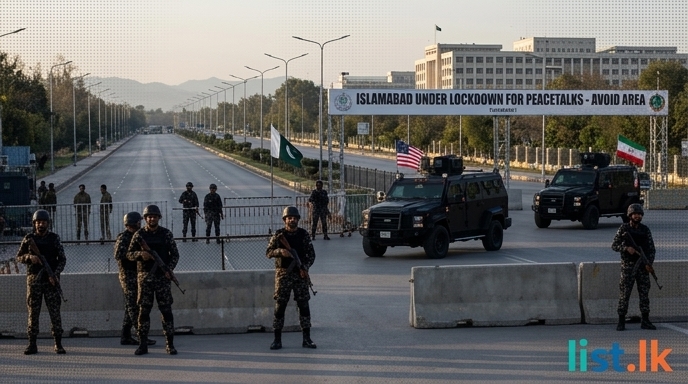
The talks, originally scheduled to begin on April 10, were officially set for April 11, 2026, in Islamabad. Diplomatic experts met on Friday, April 10, followed by lead negotiators on Saturday, April 11, with discussions extending into Sunday, April 12. Islamabad and Rawalpindi observed a two-day public holiday for the duration of the high-stakes meetings, held under a tight security lockdown with a three-kilometer security zone established around the Serena Hotel and Jinnah Conference Hall, where delegates were accommodated and met.
The US delegation was led by Vice President J.D. Vance, who was tasked by President Donald Trump to stabilize a shaky ceasefire. Vance departed for Pakistan aboard Air Force Two, expressing optimism but cautioning that the US would not be receptive if Iran "tries to play" them. He was accompanied by Special Representative Steve Witkoff and Jared Kushner. Iran's delegation was led by Foreign Minister Abbas Araghchi, and included Parliament Speaker Mohammad-Bagher Ghalibaf, who was confirmed as part of the negotiating team.
Prior to the commencement of the talks, Iran's Parliament Speaker Ghalibaf had stated that a ceasefire in Lebanon and the release of Iran's blocked assets were prerequisites for negotiations, claiming these measures were previously agreed upon but unfulfilled. A senior Iranian source later reported that the US had agreed to release Iranian frozen assets held in Qatar and other foreign banks, a move seen by Iran as a sign of "seriousness" and linked to ensuring safe passage through the Strait of Hormuz. This claim, however, remained unconfirmed by the US.
The two-week ceasefire, announced by President Trump, was put in place for a six-week war and had halted US and Israeli airstrikes on Iran. However, it had not ended Iran's blockade of the Strait of Hormuz, which continued to disrupt global energy supplies. Pakistan played a crucial facilitation role, with both US Vice President Vance and Iranian Parliament Speaker Ghalibaf meeting separately with Pakistani Prime Minister Shehbaz Sharif before the talks officially began.
While initial reports suggested the talks would be indirect, with delegations in separate rooms, later updates confirmed their direct nature. The discussions progressed to a specialist-level stage, involving expert committees on economic, military, legal, and nuclear issues.
However, US Vice President J.D. Vance announced early Sunday that the negotiations had concluded without an agreement, as Iran refused to accept American terms regarding its nuclear program. Vance stated that the US sought an "affirmative commitment" from Iran not to pursue nuclear weapons or the tools to develop them quickly, confirming that the US had presented its "best and final proposal." Despite the lack of agreement, Vance maintained that the US had approached the talks "in good faith" and was in constant communication with President Trump throughout the 21-hour process. Iran's Foreign Ministry described the talks as "tough," urging Washington to avoid "excessive and illegal demands."
President Donald Trump reportedly declared that the US had "won the war" against Iran, irrespective of the talks' outcome. Iran, for its part, disputed US claims regarding the passage of two American ships through the Strait of Hormuz. The outcome of these discussions is crucial for the fragile two-week ceasefire and the potential reopening of the Strait of Hormuz, which remains blocked by Iran.