list.lk
IMF Warns Middle East Conflict Threatens Global Economic Growth and Stability
The Pulse
EconomyPoliticsWorldHOTThursday, April 16, 2026

IMF Warns Middle East Conflict Threatens Global Economic Growth and Stability

TLDR
  • IMF warns Middle East conflict threatens global growth and stability.

  • US-Iran tensions drive 2026 growth forecast down to 3.1%.

  • Strait of Hormuz disruption impacts 1/5 oil, 1/4 LNG supply.

  • Escalation risks global recession; China and Europe are vulnerable.

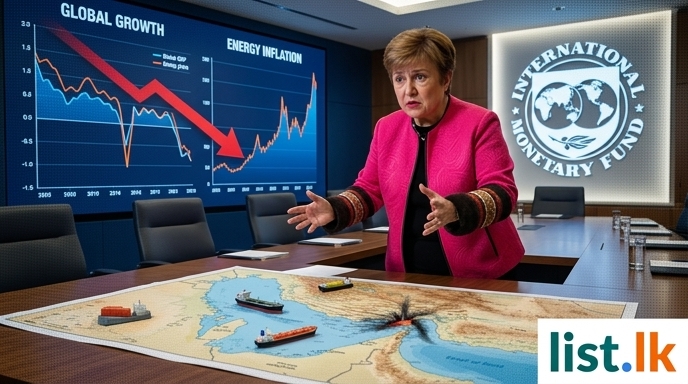
The International Monetary Fund (IMF) has issued a stark warning that the ongoing conflict in the Middle East is poised to significantly slow global economic growth and fuel inflation. IMF Managing Director Kristalina Georgieva highlighted that the war, particularly the disruption of oil and gas shipments through the Strait of Hormuz, represents a severe disturbance to global energy supply. Consequently, the IMF has downgraded its global growth forecast for 2026 to 3.1% and for 2027 to 3.2%, a reduction from earlier projections. This conflict is identified as the third major shock to the world economy, following the COVID-19 pandemic and the Russia-Ukraine war, with developing nations expected to bear the heaviest burden through increased energy, food, and fertilizer costs. The institution cautioned that an escalation could push global growth down to 2%, nearing a recession, and is now presenting multiple economic scenarios due to heightened uncertainty, as discussed during the recent IMF and World Bank Spring Meetings.

2 Updates

Update #3\u00b7 Apr 17 · 5:16 AM

The International Monetary Fund (IMF) has provided further details on the economic impact, with Jihad Azour, Director of the IMF’s Middle East and Central Asia Department, describing a "broad and deep shock" to the global economy. This shock is severely affecting energy markets, commodity supply chains, and financial stability. A key concern is the Strait of Hormuz, a critical trade artery, where disruptions impact one-fifth of the world’s oil supply and one-quarter of global liquefied natural gas (LNG) trade. The IMF warns that a prolonged conflict leading to sustained oil price increases could trigger a global economic recession and a decline in GDP growth. Regionally, the US economy remains relatively robust due to significant investments in AI technology, while China and Europe are particularly vulnerable to rising energy prices and supply chain disruptions.

Update #2\u00b7 Apr 16 · 9:50 AM

The International Monetary Fund (IMF) has specified the US-Iran military situation as the primary driver of the economic burden. Under the assumption of a limited conflict, global economic growth is projected to slow to 3.1% in 2026 and 3.2% in 2027. Global inflation is expected to slightly increase in 2026 before decreasing in 2027. The IMF further warns that a global recession could occur if peace talks fail and the US-Iran conflict escalates.

WhatsAppPost on X

Pulse Check — How do you feel?

Sign in to vote

Discussion

No comments yet. Be the first to share your thoughts!