Global crude oil prices have experienced intense and sustained volatility over recent months, primarily driven by escalating tensions between the United States and Iran, regional conflicts, and shifting geopolitical dynamics. After a period of significant fluctuations, prices have recently seen a renewed upward trend, with analysts warning of direct impacts on importing nations like Sri Lanka.
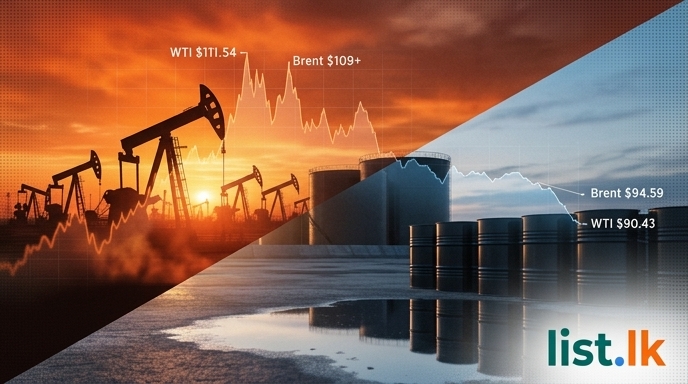
Initial market movements saw WTI Crude reach $111.54 per barrel and Brent Crude surpass $109. This was followed by a decline, pushing Brent Crude to $94.59 and WTI Crude to $90.43, as prospects for US-Iran peace talks in Islamabad emerged. However, renewed uncertainty quickly led to another increase, with Brent Crude reaching $96.25 and WTI Crude at $90.15. Early reports also highlighted a US Navy seizure of an Iranian vessel and Iran's threats concerning the critical Strait of Hormuz.
On April 11th, Iran's closure of the Strait of Hormuz in response to US airstrikes caused prices to surge, with Brent crude reaching $95.40 and WTI crude hitting $92.63. The following day, April 12th, prices fell below $90 after the US cancelled planned strikes, with Brent crude at $89.33 and WTI crude at $86.74. A further decline to $83.91 for Brent and $80.89 for WTI was attributed to a US-Iran agreement.
By April 24, 2026, prices saw a fresh increase, with Brent crude rising by 1.22% to USD 106.35, WTI crude climbing by 1.17% to USD 96.97, and Murban crude increasing by 2.74% to USD 105.95.
The upward trend continued into April 29, 2026, with Brent crude surging by 3.22% to USD 114.84 and WTI crude by 3.61% to USD 103.54. A significant milestone was reached when the price of a crude oil barrel surpassed the USD 120 mark, reaching its highest level since June 2022. This surge was attributed to the prolonged diplomatic conflict between the United States and Iran, concerns over the United Arab Emirates' (UAE) potential withdrawal from OPEC, US President Donald Trump's remarks hinting at a prolonged blockade of Iranian ports, and fears of escalating regional conflict due to the continued closure of the Strait of Hormuz.
On April 30, 2026, Brent crude reached USD 120.07 (a 1.73% increase), while WTI crude climbed to USD 107.54. Murban crude also saw a 6.34% increase. This latest surge was explicitly linked to the UAE's decision to withdraw from OPEC and OPEC+ organizations, alongside ongoing military and political instability in the Middle East. Economic analysts warned that these global price increases were expected to directly impact Sri Lanka's domestic fuel price formula.
Further volatility was observed around April 30, 2026, with prices experiencing a sharp increase of approximately 6% in 24 hours. This was driven by intensified attacks by Iran on vessels in the UAE and Gulf region, marking the most severe conflict since an early April US-Iran ceasefire. Brent crude rose by 6.3% to USD 114.96, and WTI crude climbed by 4.2% to USD 106.17. Separately, on the same day, Brent was reported at USD 120.00 (a 1.73% increase) and WTI at USD 107.60 (a 0.62% increase), attributed to renewed US threats against Iran and continued hints of a Strait of Hormuz blockade.
By May 15, 2026, WTI crude rose by 1.41% to USD 102.60, and Brent crude increased by 1.21% to USD 107.00. Murban crude reached USD 104.70. These movements followed earlier reports of Brent at USD 104.1 and WTI at USD 98.51, linked to US President Donald Trump's disagreement with Iran's response to a war-ending proposal.
Between May 4-5, 2026, prices saw another increase, with Brent crude rising by 1.32% to USD 110.70 (its highest since May 5th) and WTI crude climbing by 1.75% to USD 107.26 (its highest since May 4th). These movements were attributed to stalled efforts to end the US-Israel war against Iran and an attack on a nuclear power plant in the UAE.
On May 18, 2026, prices surged again, with Brent crude up 1.85% to USD 111.28 and WTI crude up 2.32% to USD 107.87. This was linked to US President Donald Trump's warning that time was running out for Iran peace talks. The ongoing closure of the Strait of Hormuz by Iran, in retaliation for US-Israel attacks that began on February 28, continued to significantly impact global energy markets, as approximately one-fifth of the world's oil and liquid natural gas transits through this vital shipping lane.
However, the week leading up to May 27, 2026, saw a notable decrease, reversing the previous upward trend. Brent crude fell to USD 97.33, and WTI crude also dropped to USD 97.33. Murban crude was recorded at USD 95.05, with several major crude oil types trading below USD 100 per barrel.
This decline was short-lived. On May 28, 2026, prices saw a renewed increase following retaliatory actions and warnings between the US and Iran. Iran's military warned of targeting US military bases in the Middle East in response to US attacks on Bandar Abbas, Iran. This, coupled with the shooting down of four Iranian drones near the Strait of Hormuz by US forces, led to Brent crude rising by 3.75% to USD 97.80 and WTI crude climbing by 4.00% to USD 92.22.
By June 1, 2026, prices surged again after Iran temporarily halted indirect peace talks with the US, protesting Israeli attacks on Lebanon. Mutual attacks between US and Iranian forces over the past weekend and ongoing uncertainty regarding the Strait of Hormuz further drove prices up, with Brent crude rising by 2.37% to USD 93.28 and WTI crude climbing by 2.71% to USD 89.73.
More recently, on June 3, 2026, global crude oil prices saw a significant increase. WTI crude rose by 1.24% to USD 94.92, Brent crude by 1.08% to USD 97.04, and Murban crude by 1.76% to USD 96.09.
By June 10, 2026, prices showed a mixed trend. WTI crude increased by 0.85% to USD 88.95, and Brent crude by 0.96% to USD 92.33. In contrast, Murban crude saw a decline of 3.98% to USD 88.24.
Further declines were observed on June 16, 2026, with Brent crude at $81.9 and WTI crude at $78.36. The Bank of Japan's interest rate hike to 1% from 0.75% was partly attributed to global energy price increases. The downward trend continued on June 17, 2026, with prices falling below $80 per barrel. WTI crude traded around $76.28, Brent crude reached $79.13, and Murban crude dropped to $71.81. This represented a notable decrease from the $68-$70 per barrel range observed when the Middle East conflict initially began. By June 18, 2026, prices reached levels comparable to a year ago, with WTI crude at $73.83, Brent crude at $76.64, and Murban crude at $71.02. This significant drop was attributed to a temporary peace agreement between the US and Iran, leading to the reopening of the Strait of Hormuz and fostering investor confidence.
By June 25, 2026, global crude oil prices continued their decline, with WTI crude trading around $69.93-$70.05 and Brent crude at approximately $73.32-$73.74. Murban crude fell to $66.45. WTI crude even dropped below the $70 per barrel threshold to $69.29, with Brent at $72.49. These figures were comparable to the $68-$70 per barrel range observed before the conflict's escalation, marking a significant drop from the $126 per barrel peak reached in April.
However, this downward trend was sharply reversed on July 8, 2026, as global crude oil prices saw a significant increase. This surge followed an announcement by US President Donald Trump that the ceasefire with Iran had ended, raising fears of renewed conflict and oil supply disruptions. Brent crude rose by 5.95% to $78.50, while WTI crude also increased by 5.95% to $74.60. Separately, prices climbed by over 5% after Iran reportedly attacked merchant ships in the Strait of Hormuz, prompting the US to reinstate sanctions against Iranian oil exports and launch retaliatory strikes against Iranian Revolutionary Guard Corps targets. Following these developments, Brent crude reached $75 and WTI crude rose to $72.
On July 9, 2026, crude oil prices continued their surge following renewed hostilities. WTI crude reached $74.28 (up 1.03%), Brent crude climbed to $78.81 (up 1.01%), and Murban crude rose to $73.57 (up 6.67%). These increases were attributed to the US launching a new series of attacks on Iran and declaring the recent peace agreement invalid.
Most recently, on July 13, 2026, global crude oil prices saw another significant increase as Iran expanded its attacks on Gulf region countries, threatening energy transportation through the Strait of Hormuz. Brent crude rose by $2.34 (3.08%) to $78.35, while WTI crude increased by $2.21 (3.09%) to $73.62. Other reports indicated Brent crude reaching $79.29 and WTI crude at $74.52. The International Energy Agency's monthly report noted that while global oil supply increased by 4.1 million barrels per day in June, it remains 9.4 million barrels per day lower than pre-war levels.
The volatility underscores the profound impact of geopolitical tensions, particularly those involving the US and Iran, on global energy markets, with direct implications for importing nations like Sri Lanka.