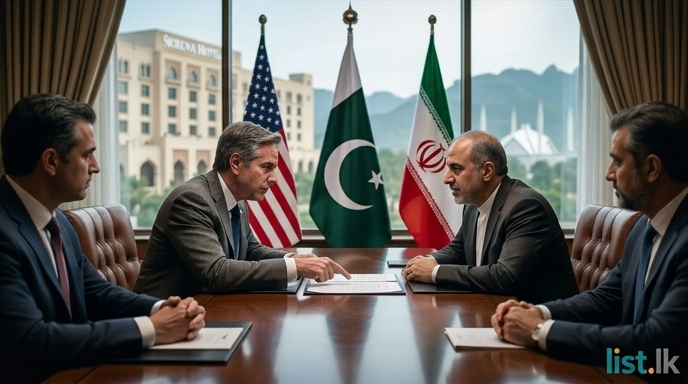
Diplomatic efforts to de-escalate tensions between the United States and Iran have intensified in Islamabad, Pakistan, with Pakistan playing a pivotal mediating role. The initial round of direct peace talks between the two nations commenced on April 10, 2026, at the Serena Hotel in the Pakistani capital, concluding on April 11. This marked a significant milestone as the first face-to-face meeting between US and Iranian officials since 1979.
The US delegation for these initial discussions included Vice President J.D. Vance, Jared Kushner, and Steve Witkoff, while Iran was represented by Parliament Speaker Mohammad Bagher and their Foreign Minister. Iranian Foreign Ministry spokesperson Esmaeil Baqaei described the discussions as "very intense." Although the first round concluded without a formal agreement, US Vice President Vance hinted that some progress was achieved, viewing the discussions as part of an ongoing diplomatic process. Pakistan's Defense Minister Khawaja Asif noted positive signs for the resumption of diplomatic relations.
Pakistan implemented extensive security measures for the initial talks, including declaring a two-day public holiday in Islamabad, taking control of the Serena Hotel, evacuating guests, and establishing a three-kilometer security perimeter. Pakistan's mediatory efforts, which also involved conveying a 10-point proposal from Iran to the U.S., have garnered global recognition. Turkey has also emerged as a major mediator.
Following the initial talks, a two-week ceasefire, declared by US President Donald Trump on April 8, was in effect. On April 15, Pakistani Army Chief Field Marshal Asim Munir led a high-level delegation to Iran, carrying a new message from Washington aimed at restarting discussions and potentially extending the temporary truce. He was welcomed by Iranian Foreign Minister Abbas Araghchi.
Despite these diplomatic overtures, tensions persisted. The US military confirmed a complete halt to economic trade by sea due to its blockade in the Strait of Hormuz. In response, Iran's army warned it would block trade through the Red Sea, the Gulf, and the Sea of Oman if the US naval blockade continued.
Expectations for a second round of talks have fluctuated significantly. Initially, a second round was anticipated, with Pakistan proposing to host it before the ceasefire expired. On April 19, reports indicated that a second round was expected to commence that week, with an Iranian delegation, including Foreign Minister Abbas Araghchi and Parliament Speaker Mohammad Bagher Ghalibaf, set to arrive. However, on April 20, Iran's foreign ministry spokesperson Esmaeil Baghaei stated there was no plan for the next round of negotiations, citing a lack of seriousness from the US and repeated ceasefire violations. This stance was reiterated on April 23, with Iran stating it would not engage in peace talks amidst US President Donald Trump's threats and pressure.
Despite Iran's public denials of planned negotiations, developments continued. On April 20, Pakistan Prime Minister Shehbaz Sharif held a telephone conversation with Iranian President Masoud Pezeshkian, reaffirming Pakistan's commitment to regional peace. On April 23, PM Sharif also met with Iran's Ambassador to Pakistan to discuss the situation. By April 24, Iran's Foreign Minister Abbas Araghchi was expected to travel to Islamabad as early as Friday, and he arrived in Islamabad on Friday, April 25. US President Donald Trump stated that Iran planned to make an offer aimed at satisfying US demands, though details were unknown.
On Saturday, April 26, US President Donald Trump's special envoy Steve Witkoff and Jared Kushner were expected to arrive in Islamabad. White House Press Secretary Karoline Leavitt confirmed that a special US delegation had been dispatched to Pakistan for talks aimed at a diplomatic resolution. However, Iran's Foreign Ministry spokesperson Esmaeil Baghaei explicitly stated that no meeting between Iranian and American negotiators was planned in Pakistan, despite the presence and expected arrival of both delegations. Baghaei clarified that Foreign Minister Araghchi's purpose in Pakistan was to communicate Iran's observations and discuss Pakistan's mediation efforts with Pakistani officials.
Upon his arrival, Iranian Foreign Minister Abbas Araghchi held a series of high-level meetings in Islamabad. He met with Pakistan's head of armed forces, Field Marshal Asim Munir, to discuss the latest developments related to the ceasefire and share Iran's views on ending the conflict. Araghchi also met with Pakistan's Deputy Prime Minister and Foreign Minister, Mohammad Ishaq Dar, before holding talks with Pakistani Prime Minister Shehbaz Sharif at the Prime Minister's House. During these discussions, both parties reportedly exchanged views on Iran-Pakistan relations and strengthening cooperation. Pakistan has consistently reaffirmed its readiness to continue its mediation role, with its foreign ministry warning against updates from unofficial sources.