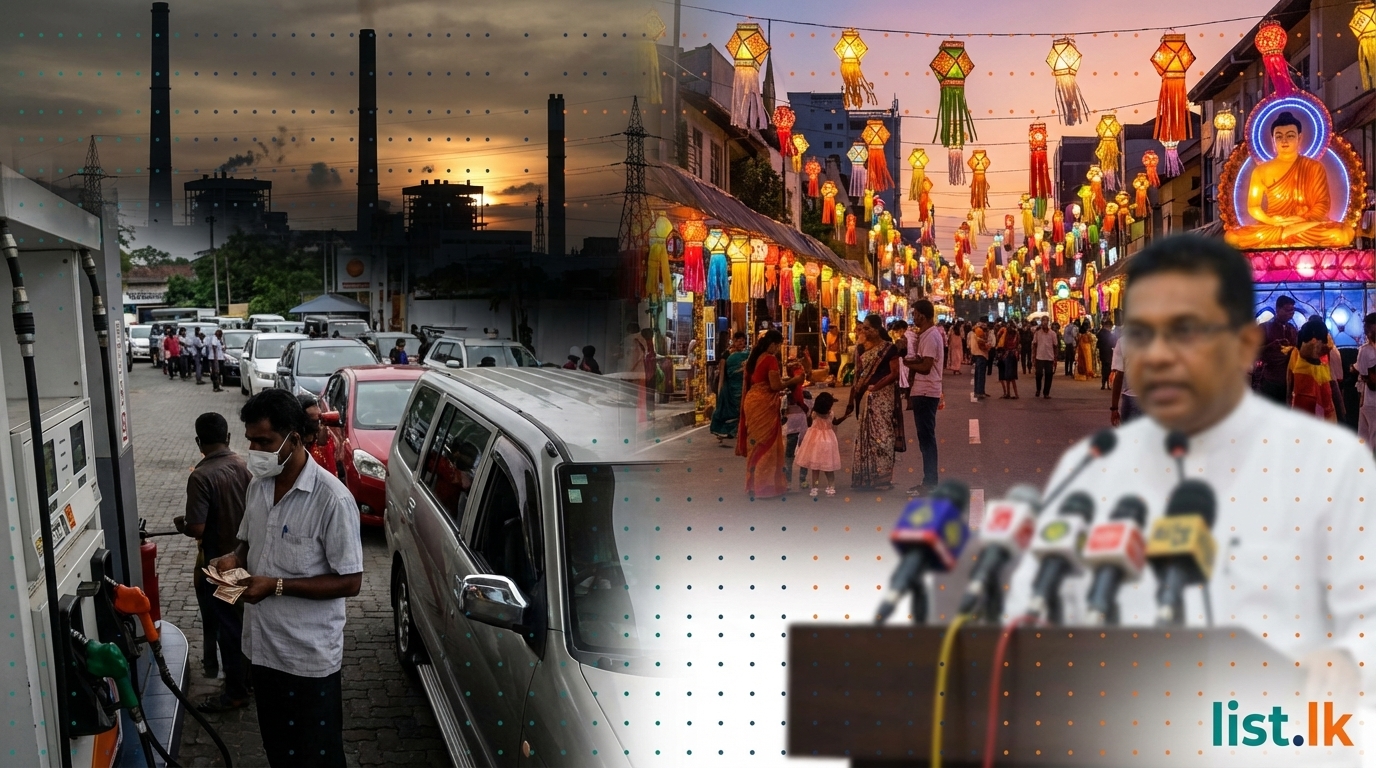
Sri Lanka is actively addressing a multifaceted energy crisis and economic challenges while simultaneously preparing for major religious festivals and implementing various social and administrative reforms. The Cabinet has confirmed that there will be no electricity supply restrictions during the upcoming Vesak and Poson festivals, despite ongoing energy conservation efforts. To manage consumption, Wednesdays have been declared public holidays for non-essential services, and state institutions are mandated to switch off air conditioning after 3:00 p.m. and advertising lights after 8:00 p.m. Local authorities are instructed to coordinate with police when turning off street lights between 6:00 p.m. and 10:00 p.m., avoiding high-crime or accident-prone areas. However, the All Ceylon Motorcyclists' Association has strongly protested this street light decision, announced by the Essential Services Commissioner General on March 30th, citing road safety concerns.
In a move to reduce fuel consumption, Ministers and MPs have agreed to a voluntary 30% cut in their fuel quotas, with fuel allowances for officials now based on March 1, 2026 prices. The Ministry of Health and Mass Media has already achieved a significant 42% reduction in diesel consumption by March 31. Parliamentarian D.V. Chanaka has raised concerns, claiming only 40% of the country's fuel storage tanks are filled, despite capacity for over two months of diesel, and alleged that renovation projects for tanks in Kolonnawa and Trincomalee were halted by the current administration. To further promote energy efficiency, awareness programs are scheduled for schools on April 7 and 9, and online for universities. The Cabinet-appointed committee overseeing public services is also exploring the feasibility of online work for public sector employees on April 16 and 17.
Economically, the Public Utilities Commission of Sri Lanka (PUCSL) approved an overall 10% increase in electricity tariffs from April 1, with state institutions facing a 14.4% hike. For domestic consumers, the tariff for the 0-30 units category increased by 4.3% (Rs. 15 monthly), while the 31-60 and 61-90 units categories saw a 6.9% rise (Rs. 45 monthly for the former). Deputy Minister Eranga Gunasekara acknowledged the public burden from these increases, noting that the treasury has been filled by taxes on everyday items, and emphasized the need to conserve 25% of the country's energy. These tariff adjustments have led to increased food prices, with fried rice and kottu rising by Rs. 30, short eats, parata, and egg roti by Rs. 10, and plain/milk tea by Rs. 5.
The Sri Lanka Rupee depreciated by 1.6% against the US dollar in 2026, with the selling rate reaching Rs. 319.31 and buying rate at Rs. 311.76 by March 31, attributed to external sector pressures from the Middle East conflict. However, the Rupee remained steady at a general selling rate of Rs. 318 against the US dollar on April 2. Foreign worker remittances saw a significant 32% increase in the first two months of 2026, totaling USD 1,480.1 million, with USD 729 million recorded in February alone, a 33% rise from the previous year. Foreign reserves stood at USD 7.3 billion by the end of February, while vehicle imports cost USD 418 million for the same period. The country faces a projected shortage of Samba and Keeri Samba rice from May 2026, prompting cabinet approval for imports. A looming urea fertilizer crisis is also anticipated for the 2026 Yala season, with just over 100,000 tonnes in stock and many expected imports cancelled or delayed, leading to rationing through Agrarian Service Centres.
An International Monetary Fund (IMF) delegation met with President Anura Kumara Dissanayake on April 2 to review Sri Lanka’s economic reform program and progress under the Extended Fund Facility, commending recent improvements in growth and revenue management. The Ministry of Finance, Planning, and Economic Development has stressed the need to manage public expenditures within existing financial limits due to the Middle East conflict's economic impact. The government has also decided not to proceed with the privatization of Sri Lanka Telecom, Air Lanka, insurance companies, and Lanka Hospitals, reversing previous government decisions.
In other developments, the National Vesak Festival will be held in Matara, centered around the Midellawala Purana Viharaya, under the theme 'Abhittharetha Kalyane', with Vesak Week declared from May 27 to June 02. The Police have initiated a special island-wide security program for the upcoming Sinhala and Tamil New Year festive season, deploying over 10,000 officers across 608 police stations for road safety and traffic checks, supported by intelligence officers for urban safety. The Ministry of Education has issued directives for strict adherence to heatwave safety guidelines in schools and a new circular on school discipline, supplementing a 2016 circular. Minister Saroja Savithri Paulraj affirmed that the absence of a birth certificate should not deny any child school education, particularly addressing concerns in Matara District's estate areas.
Cabinet approved free tourist visas for 39 countries for a period of 6 months, with approval granted on July 21, 2025, to boost tourism. Prime Minister Dr. Harini Amarasuriya emphasized safeguarding senior citizen rights and well-being at the virtual opening of the Silver Age Centre for Elderly Care, Training, and Research Centre in Kataragama on March 31st. South Korea will assist Sri Lankan local authorities in converting waste into a resource, with experts from Kumoh University, Nanotech Institute, and Hanyeong Education Foundation visiting the Beruwala Urban Council and conducting workshops on nanotechnology for waste incineration and plastic production. The Department of Land Settlement, established in 1903, is reviewing its 28-year-old ordinance for modernization, with plans to increase its 52 regional offices to 80. A local pharmaceutical plant in the Pallekele Investment Zone has begun producing medical equipment kits for home dialysis for kidney patients, alongside other medicines. Deputy Minister Upali Samarasinghe launched a Rs. 2.5 million project in Vavuniya to develop difficult schools, including donating musical instruments and smart boards to Maradamaduwa Dharmapala Vidyalaya. The Hambantota International Port Group (HIPG) signed a USD 108 million investment agreement with Shanghai Zhenhua Heavy Industries Company (ZPMC) for new crane equipment to expand its container operations. The Urban Development Authority launched the "Metro Uplift" project for 24 Colombo apartment complexes, with the first phase at Kolonnawa's Laksada Sevana Housing Complex, involving an investment exceeding Rs. 128.8 million.
Controversially, a no-confidence motion against Energy Minister Kumar Jayakody is scheduled for debate and vote on April 10th, with government MPs instructed to remain in Colombo. Open warrants have been issued by the Colombo Magistrate's Court for Shamindra Rajapaksa, son of former minister Chamal Rajapaksa, and Priyanka Neomali Wijenaike, wife of former SriLankan Airlines CEO Kapila Chandrasena, in connection with the Airbus bribery case. MP Prasad Siriwardhana alleged that the government is preparing to promote a retired individual involved in the Easter attack investigations within the security forces, in violation of public service rules. An audit report by the National Audit Office revealed that 13 Samurdhi Development Officers in Galle District submitted unverified G.C.E. Ordinary Level certificates, recommending swift action. The Excise Department reported a 60% increase in excise revenue over the past three years, collecting LKR 170 billion in 2022, attributed to the security sticker project on liquor bottles. Finally, the first national guidelines for oxygen use in government hospitals have been launched under Health and Mass Media Minister Dr. Nalinda Jayatissa, with UNICEF support, to streamline oxygen management and enhance technical understanding among health professionals, followed by training for one hundred staff.