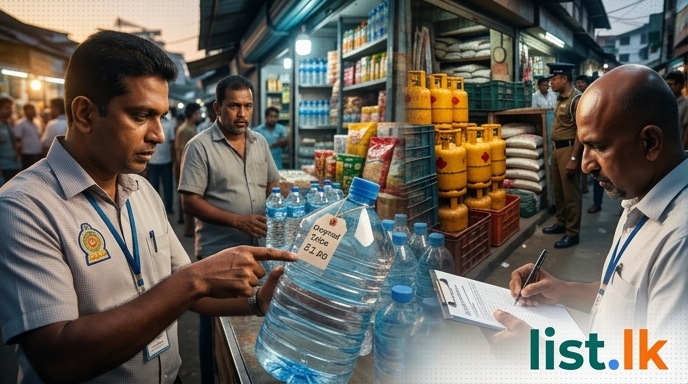
The Consumer Affairs Authority (CAA) has significantly intensified its nationwide campaign against businesses violating consumer protection laws, leading to substantial fines and legal actions across Sri Lanka. In the first four months of 2026, the CAA has imposed fines exceeding Rs. 89 million on traders, following 7,334 raids conducted islandwide. The highest number of operations, 654, was reported from the Kurunegala District.
The crackdown targets a range of offenses, including overpricing essential goods, hoarding supplies, and selling expired products. Enforcement actions have been widespread, with the CAA utilizing its 1977 consumer hotline and undercover officers to identify violations.
Recent incidents highlight the Authority's rigorous approach:
* Early April: A Kandy restaurant faced legal proceedings after an April 4 raid for selling bottled water above the controlled price. On April 20, a separate Kandy shop faced legal action for hoarding gas stocks and falsely claiming unavailability.
* April 24: The Bandarawela Magistrate’s Court imposed a hefty Rs. 1 million fine on a Haputale restaurant for overpricing bottled water, while an Anuradhapura merchant was fined Rs. 100,000 for a similar offense. On the same day, a businessman in Trincomalee was fined Rs. 100,000 for overpricing Keeri Samba rice. Widespread raids were conducted in areas including Kandy, Trincomalee, Galle, Tangalle, Girandurukotte, and Haputale, targeting establishments selling rice and bottled water above stipulated maximum retail prices.
* April 27: The Galle Additional Magistrate’s Court imposed a total fine of Rs. 200,000 on two traders in Galle for selling rice above the Maximum Retail Price (MRP). The Embilipitiya Magistrate's Court fined a store in Embilipitiya Rs. 500,000 for overpricing Keeri Samba rice.
* April 28: A trader in Colombo 11 was fined Rs. 200,000 by the Maligakanda Magistrate's Court for selling Samba rice above its MRP, with proceedings revealing the merchant had committed similar offenses on two previous occasions. Additionally, a vendor at the canteen of the ‘Meenagaya’ train (operating between Colombo and Batticaloa) was penalized Rs. 100,000 for selling 1000ml drinking water bottles at Rs. 160, significantly above the MRP of Rs. 100.
* April 29: The Dambulla Magistrate’s Court imposed a Rs. 510,000 fine on a Dambulla restaurant for selling expired drinking water bottles above their MRP (a bottle with an MRP of Rs. 70 was sold for Rs. 100). The Maligakanda Magistrate’s Court also fined a restaurant within a Colombo 04 shopping mall's food court Rs. 500,000 for selling 500ml bottled drinking water at Rs. 80 above its MRP.
* May 2: Special raids in the Piliyandala area led to the apprehension of a trader at the Bokundara Economic Centre for selling Keeri Samba rice at Rs. 360 per kilogram, exceeding the MRP.
* May 4: A shop in Navagamuwa, Ranala, was fined Rs. 100,000 for selling imported Keeri Ponni rice above the MRP.
* May 5: A supermarket in Wellawatte was fined Rs. 500,000 for selling local Nadu rice at Rs. 320 per kilogram (MRP Rs. 230). A shop in Atampitiya, Badulla, was fined Rs. 100,000 for selling Keeri Samba rice at Rs. 379 per kilogram (MRP Rs. 260).
* May 11: Legal proceedings were initiated against a shop in Mawanella for selling a 5kg pack of Keeri Samba rice at Rs. 1,950, significantly exceeding the MRP of Rs. 1,300. CAA officials in Puttalam also raided rice traders in Arachchikattuwa for overpricing.
* May 13: The Matara Magistrate’s Court imposed a total fine of Rs. 1,000,000 on two tourist hotels for overpricing bottled drinking water, with each hotel fined Rs. 500,000. Instances included selling a 1-litre bottle (MRP Rs. 100) for Rs. 450 and a 500ml bottle (MRP Rs. 70) for Rs. 300.
* May 15: The CAA filed strict legal action against traders in Marawila found selling Samba rice above the government-mandated MRP during special raids.
The CAA continues to urge consumers to remain vigilant and reject establishments that sell goods above stipulated prices, emphasizing its commitment to protecting consumer rights.
